Monday, June 23, 2014

AWESOME STUFF: Sci-Fi Tween Reader

This list was started/generated at the Sci-Fi Exploration workshop @ AMC 2014. Please share this with other rad tweens and ask them for their suggestions. Leave comments to add more awesome stuff.


Animorphs
Dr. Who
Pyro from Team Fortress 2
The Higher Power of Lucky
The Golden Compass
Homestruck
Coraline
Torchwood
Galaxy Express 999
Adventure Time
The Runaways
Lio
Ava's Demon
Deadpool
Bravest Warriors

What we want (that we don't have yet):
Sci-fi + Mythology
Super communities (not just people/individuals)


Sci-Fi Exploration (workshop for tweens ) / OR: How I learned that jumping is a super power

Wow! I can't believe its been a year since my last blog post, which was from the Allied Media Conference (AMC) 2013. But this post ties right in where we left off, from one of the potentially glorious tips: Science fiction geeks! How about creating a sci-fi workshop for tweens/young teens with accessible language? Plans started in the airport flying home to Baltimore, when I happened to meet Emil Rudicell from Dinah Press. Emil committed to making it happen this year:


SCI-FI EXPLORATION: "Do you want to change the ending? Do you make your own worlds, superpowers, and fantastical futures and pasts? Want to? This workshop is for young folks – around 9-14 years old – to share and create sci-fi and fantasy stories. We will make zines, comics, or other story guides, and start to develop a young adult reader."

Presenters:


A workshop especially for tweens 

As a bottomliner of the Kids, Caregivers, and Community Practice Space I introduced the workshop by saying that this was the one specific workshop for tweens in the kids practice space; and that there was a group of friends who had grown from children into young teens at the AMC, who were into sci-fi, that inspired this workshop to happen but they were not in attendance this year. We designed this workshop to create a space for tweens to meet each other, because we know sometimes this age group gets tired of being with younger children and older teens/adults, as well as going to radical activities w/ their parents. There is not a lot of "tweens" at the AMC & it would be good to have a space to meet each other. 


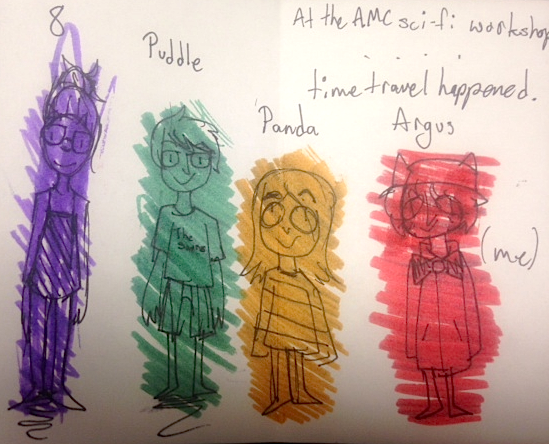
Emil started by asking us about where we come from and the things we like. To exaggerate these qualities into super powers. We discussed science fiction and ways it was like our own life; and how we could change time-lines and write our own stories.

It was Panda's first year at the AMC and they were 8. They had road-tripped for over 24 hours from Utah and this was their first workshop. It was a nice calm space after such a long trip. Argus was 13 & knew a lot about shape-shifting and astral projection because of the healers in their family. They were also a comic illustrator. (P.S. I'm using our time travel code names and gender neutral pronouns but I don't remember what pronouns the kids used)


    Emil led us in a lot of active imagining

We jumped over Mount Everest. I'm not that good of a jumper so I was scared. I imagined Mount Everest as very small since I know I can't jump that far. Argus said: "you know jumping is a kind of super power. rocks can't jump." We would turn around two times and then turn into a mythical creature. We also turned into animals. We would walk around the room and move in our new forms. I totally knew that Panda was Panda before they ever told us that! Emil told us that we could time travel into the past or future by turning around two times and then imagining that we were there. Time travel is very noisy. We all grabbed markers so we could communicate with each other and tell each other what we saw. It was really cool.


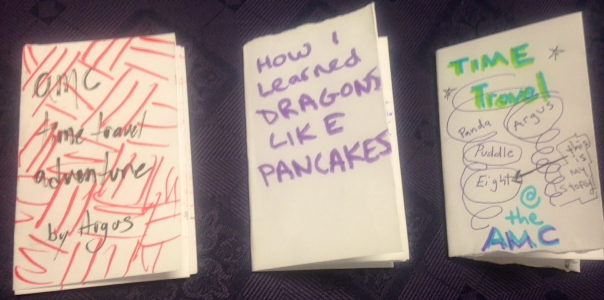
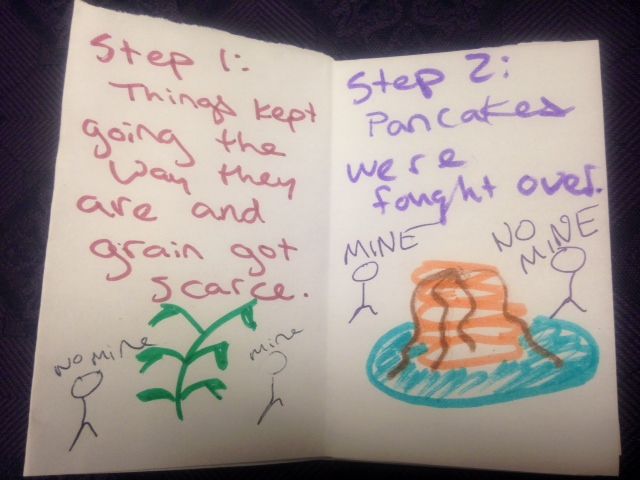
Then we made a mini zine 

We read them with each other. I was really impressed that Panda could read my messy handwriting but they didn't choose to share their zine with the group. Thats OK - you don't have to! This is Emil's zine below.


After that we brainstormed titles for the Awesome stuff list 


AWESOME STUFF: Sci-Fi Tween Reader:

(click on link above for list)

I brainstormed Coraline, although I couldn't remember the name of the movie at first. Argus and Panda kept going back and forth with ideas, saying "Oh Yea!" and "I love that too!" I was unfamiliar with most of the things they said. They really loved Dr. Who (I do too) and went through a whole bunch of Dr. Who References. I made a Star Trek reference but they didn't know it, never watched Star Trek. Emil translated for us through our generational differences. 

I was really glad I got to help with this workshop, it was a lot of fun 

We made new friends; another generation of tweens may meet up again next year. I talked with Panda the next day, and they said they had thought the AMC might not have any workshops for them, but that wasn't the case, they liked it! And asked if I had seen Argus that day. I hadn't. But I said, I bet if you don't see them later you might bump into them again a few years. And we both smiled. Its a good idea to have some workshops specifically for tweens and this workshop felt like a success even though only two people came, that was kind of great because they both had big imaginations which helped fill the room. 

thank you Emil!


Saturday, July 13, 2013

✰The Positive, the Problematic & the Potentially Glorious ✰

Suggestions Brainstormed at the “Don’t Leave Your Friends Behind” workshop at Allied Media Conference (AMC) 2013 


The Allied Media Conference (AMC) is a very special conference, dear to our hearts and one of the best ones for childcare, youth programming, and nurturing an intergenerational movement.  It builds on feedback from each year, with a we begin by listening credo, and continually works to build collective access. We want to recognize that a lot of planning and effort happens to intentionally support caregivers and children and we thank everyone involved. Please accept the more critical feedback within this list with love and as part of the ongoing conversations to help move forward for next year.


lacing cards, a chew proof baby book, & baby blocks


The Positive
  • Parents and caregivers feel excited to bring children to the AMC. One mom said that the combo of childcare + Kids’ Track makes the AMC one of the few places she wants to bring her small child.
  • Youth are excited about coming to the AMC. They get a lot out of the experience such as workshops that are engaging for youth (such as scratch, flash animation, green screen*) and build media skills they can use outside of the conference. Children can also meet others with similar kinds of parents and not feel isolated by being the only kid from a political family.
  • Non-parents enjoy seeing children around them. Having childcare be in the main space and seeing children around them feels good.
  • One mom, who was at the AMC with her two young children for the first time, said that the combo of childcare + Kids’ Track makes her very hopeful.
  • Relationships are being built and nurtured so we can also support each other in more organic ways all around, and outside of, the conference.  
  • Two of the youth are already making plans to come to next year’s AMC!

    * Although we later found out that the greenscreen workshop either didn’t happen or was moved to an undisclosed location. The tweens, as well as several adults, went to the indicated room which was empty & waited & waited & waited & finally gave up.


The Problematic
  • Youth not prioritized in “all ages” workshops. Youth arriving late to “How to Create Magical Card Decks”  felt uncomfortable and left because the workshop was crowded and full of adults. Youth can feel intimidated if a the “Kids Transform the World Practice Space” is mostly attended by adults and want to leave the room when they come in to see this is the case.
  • Unsafe equipment/supplies (such as razor blades at small child level) in some of the spaces that are listed as “Appropriate and engaging for all ages” workshops
  • Railings on 2nd floor are extremely dangerous for small children, who can easily fall through. Putting up decorative cloth on the railing only makes it more appealing and thus more of a hazard.
  • Lack of clear structure for volunteers to know what is happening and what is expected of them: A childcare volunteer said that they were given no information about kids’ names, caregivers, allergies, etc., when they came in to volunteer. It felt extremely disconnected, confusing, and upsetting to not know what one was supposed to be doing and for there to be little communication during shift changes (people just coming and going without saying anything other then goodbye) or when taking children outside.
  • No quiet, dark (or able to be darkened) room for children to nap. Also, a shortage of childcare providers means that there’s no one to watch napping kids.


The Potentially Glorious
  • Put a cap on how many adults (without children) can be in a workshop that is geared for youth.
  • Quality control to make “Appropriate and engaging for all ages” workshops both engaging AND safe. Have a check-off list for presenters to go through to make sure their space is safe.
  • Have childcare (and the Kids Track) on the 1st floor!!!
  • Have an additional nearby quiet/napping room with extra volunteers
  • Provide healthy food/snacks with regard to food allergies and restrictions
  • Childcare organizers advocate for healthy food
  • Put trigger warnings on workshop descriptions instead of labeling sessions as “not appropriate for kids.” Allow caregivers (and other adults) to choose whether to attend based on content, not a sometimes-arbitrary rating system. *
  • Give trigger warnings before the start of the workshop. (This warns people who may have forgotten/not read the trigger warning in the description.)
  • Have name tags for all kids that include caregivers’ names and allergy info. Incorporate nametag making as an art activity at the beginning of each day so that the kids feel ownership of their name tag (and are less likely to take them off).
  • Childcare volunteers should do a head-count before taking kids outside & then another before returning to the childcare space.
  • Have a short (1-2 page) orientation handout for all childcare volunteers that includes how long they’re expected to stay and WHAT is expected of them. Information needs to be shared with ALL childcare volunteers.
  • More paid (2-3) childcare staff. More childcare and Kids Transform the World Track volunteers. Also, more intersections that conference attendees can get involved in supporting caregivers and children at different comfort/commitment levels as well as more learning opportunities on how to do so.
  • Science fiction geeks! How about creating a sci-fi workshop for tweens/young teens with accessible language? Also consider other themes, like how sex-positive subject matter could also be created into a class for tweens which need this kind of information.
  • Have AMC youth scholarships to cover travel expenses so that more children can attend the conference with their caregivers. Also all different groups and collectives could consider organizing (based around geography or issues, for example) collective support/scholarships for caregivers and children in their midst.
  • Network with the Disability Justice folks to collaborate on broader platforms of access.

    * Info about difficulties in planning rating system: when organizers plan the conference they don’t know what room workshops will be in and they also edit the descriptions a lot.


Utopian
  • What if EVERYONE doing a workshop committed to :
    • keeping sharp and/or dangerous objects out of reach
    • making an announcement at the start that kid noises are welcome
    • encouraging people (of all ages) to ask for definitions/clarifications if they don’t understand terms that are used
    • giving trigger warnings

  • AMC organizers:
    • create a small working group which includes caregivers and kids on how to make the AMC more kid-friendly.
    • Create a collective vision/official statement of how the AMC wants to include children and caregivers.
    • Create a 5-year plan to work towards meeting these goals. Rushing too fast to create inclusion without necessarily understanding how to do so can create additional problems and push us past our capacities. We need to work on these issues in an extended committed fashion.


      We brought toys that would be safe for babies and all- ages because last time we didn't have anything fun for 
      all the small children in our heavily talk-based workshop 


Sunday, June 2, 2013

Suggestions brainstormed at the Montreal Anarchist Bookfair 2013


check in table

What are some ways to support families in your midst?


  • Having youth-led workshops. Have the kids/youth lead a workshop for everyone!
  • Include images of children in the outreach & publicity to show that kids (and all ages) are welcome to your event. Welcome children’s artwork and participation in the media making process.
  • Don’t marginalize the kids’ space and caregivers so that they’re excluded from the larger event.
  • Don’t marginalize supporting families as being only “parents and kids” issues.
  • Follow through on what you offer. Get support of your own to help you process your own issues and boundaries so you can be clear on what you can offer, and take care of yourself while supporting others.
  • Learn from doula-ism: Many new moms are reluctant to ask for help with basic things (like doing dishes, cooking meals). Offer to do these things so that they don’t have to. Cook in bulk so that they can freeze leftovers and reheat them later.
  • It shouldn’t be on parents to lead the call for childcare.
  • Create different ways of participating in demos for those who would be left behind on a long walk. For example, one group rented a bus to bring children, parents, and others who couldn’t march the entire way.
  • If parents are willing to open their homes to meetings, those would ensure that the space is kid-friendly and kid-welcoming. However everyone should plan to pitch in with set-up and clean-up.
  • Parent should feel okay asking for help. Create a culture in which it’s okay to ask for help.
  • Offer resources for parents if you feel they could benefit from them.
  • For white parents not teaching their kids about race, offer resources to talk about other races, ethnicities and cultures.
  • Offer to collectively help parents get/pay for resources that they can’t otherwise afford (like cloth diapers).
  • Volunteer with the Montreal Childcare Collective.
  • Offer alternatives rather than criticisms.


    Thank You: Montreal Anarchist Bookfair, Montreal Childcare Collective, and QPIRG ! < 3


Thursday, April 4, 2013

Don't Leave Your Friends Behind at NYC Anarchist Bookfair, Sat April 6, 1-2 pm

This Saturday afternoon, DLYFB contributor and mama Jennifer Silverman and I will be facilitating a discussion on ways to create family-friendly, all-ages spaces in our movements and communities as part of the NYC Anarchist Bookfair.

Note that we are NOT at the main bookfair venue. We will be speaking at:

ABC No Rio

156 Rivington Street (between Clinton and Suffolk Streets)

Get directions here.

Wednesday, February 20, 2013

Don't Leave Your Friends Behind in Washington, DC! Sat, March 9

DC BOOK RELEASE PARTY  
for
Don’t Leave Your Friends Behind: 
Concrete Ways to Support Families in Social Justice Movements and Communities
 
featuring co-editors Vikki Law, China Martens, and area contributors. 
 

March 9, 2013, at 5 pm

St. Stephen’s Auditorium
1525 Newton St. NW Washington, DC 20010
phone: 202-487-8698
 
Join co-editors China Martens and Vikki Law along with Mark Andersen of Positive Force and We Are Family for a discussion and celebration on ways that social justice movements and communities can support the families in their midst.

This event is for all ages. Bring your families and loved ones!